+86 13012999975
- English
- Chinese
- French
- German
- Portuguese
- Spanish
- Russian
- Japanese
- Korean
- Arabic
- Irish
- Greek
- Turkish
- Italian
- Danish
- Romanian
- Indonesian
- Czech
- Afrikaans
- Swedish
- Polish
- Basque
- Catalan
- Esperanto
- Hindi
- Lao
- Albanian
- Amharic
- Armenian
- Azerbaijani
- Belarusian
- Bengali
- Bosnian
- Bulgarian
- Cebuano
- Chichewa
- Corsican
- Croatian
- Dutch
- Estonian
- Filipino
- Finnish
- Frisian
- Galician
- Georgian
- Gujarati
- Haitian
- Hausa
- Hawaiian
- Hebrew
- Hmong
- Hungarian
- Icelandic
- Igbo
- Javanese
- Kannada
- Kazakh
- Khmer
- Kurdish
- Kyrgyz
- Latin
- Latvian
- Lithuanian
- Luxembou..
- Macedonian
- Malagasy
- Malay
- Malayalam
- Maltese
- Maori
- Marathi
- Mongolian
- Burmese
- Nepali
- Norwegian
- Pashto
- Persian
- Punjabi
- Serbian
- Sesotho
- Sinhala
- Slovak
- Slovenian
- Somali
- Scots Gaelic
- Shona
- Sindhi
- Sundanese
- Swahili
- Tajik
- Tamil
- Telugu
- Thai
- Ukrainian
- Urdu
- Uzbek
- Vietnamese
- Welsh
- Xhosa
- Yiddish
- Yoruba
- Zulu
- Kinyarwanda
- Tatar
- Oriya
- Turkmen
- Uyghur

Does a UPS Protect Against Power Surges? What Buyers Need to Know
2026-10-17
A UPS can provide some protection against power surges, but it should not automatically be treated as a complete surge-protection solution. Its actual protection depends on the model, internal protection design, operating mode, and installation. A UPS primarily provides temporary backup power when utility power fails; some models also condition incoming power and suppress certain transients. A dedicated surge protective device (SPD) may still be needed to manage surge energy at the building or distribution level.
For businesses protecting servers, network equipment, industrial controls, or other critical loads, the key question is not simply whether a UPS includes surge protection. Buyers should confirm what the selected model is designed to withstand, how it behaves in bypass, and how it coordinates with upstream protection.
What Is a Power Surge?
A power surge is a short-duration rise in voltage above the expected level. Surges can be associated with lightning-related events, utility switching, or switching operations inside a facility. A surge is different from sustained overvoltage, a voltage sag, or a complete power outage, and those conditions may require different protective responses.
Sensitive electronic loads—including servers, network devices, communications equipment, and industrial control electronics—can be affected by transient overvoltage. Damage is not always immediate: repeated electrical stress may also contribute to premature component failure. A circuit breaker or fuse primarily addresses overcurrent conditions; it should not be assumed to provide surge protection by itself.
How Does a UPS Protect Against Power Surges?
A UPS sits between the utility supply and connected equipment. Depending on its design, it may provide battery backup, voltage regulation, filtering, and some level of transient suppression. These functions are related, but they are not interchangeable. Battery backup keeps compatible loads powered during an outage; voltage regulation responds to certain sustained variations; surge suppression limits short voltage transients within the device’s specified capability.
There is no single surge-protection level that applies to every UPS. Buyers should check the exact model’s technical documentation for surge ratings, protection modes, relevant test conditions, and limitations. Do not infer a specific joule rating, clamping voltage, or lightning withstand capability from the words “UPS,” “online,” or “double conversion” alone.
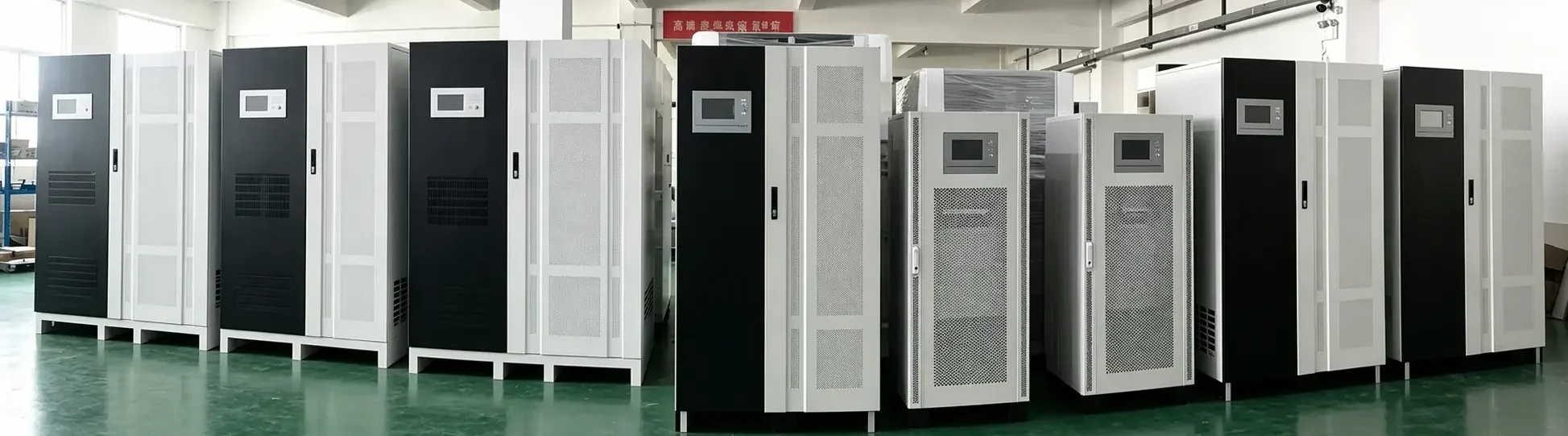
USYTU’s UPS product range includes multiple system types and capacity ranges. The appropriate protection functions must be verified against the selected product’s own specification and the site’s electrical design.
UPS vs. Surge Protector vs. Surge Protective Device (SPD)
These devices have different primary roles. A UPS provides short-term backup power and may condition incoming electricity. A surge protector or SPD is designed to limit transient overvoltage. Depending on the installation, a coordinated protection scheme may use both rather than relying on either device alone.
| Device | Primary role | What buyers should verify |
| UPS | Backup power during utility interruptions; additional power-conditioning features vary by model. | Topology, load capacity, battery configuration, bypass behavior, and documented surge protection. |
| Plug-in surge protector | Limits certain transient voltages for connected equipment. | Rated protection level, compatibility, grounding, and application suitability. |
| Installed SPD | Provides surge protection at a defined point in the electrical distribution system. | System voltage, installation location, grounding, coordination, and applicable electrical requirements. |
For commercial or critical-power installations, the protection arrangement should be designed for the actual distribution system. The location and rating of SPDs depend on the electrical installation, equipment instructions, and local code requirements; they should not be prescribed from a general article alone.
Does UPS Topology Affect Surge Protection?
UPS topology affects how the unit processes incoming power, but topology alone does not prove a particular surge rating.
Standby UPS
A standby UPS normally supplies utility power to the load and transfers to battery operation when a qualifying input problem occurs. Its filtering and surge-protection capabilities vary by model, so check the manufacturer’s documentation rather than assuming a fixed protection level.
Line-Interactive UPS
A line-interactive UPS typically adds voltage-regulation capability to battery backup. That can help with certain voltage variations, but voltage regulation and transient surge suppression remain different functions.
Online Double-Conversion UPS
An online double-conversion UPS continuously converts incoming AC power to DC and then back to AC during normal online operation. This architecture can provide a controlled output for suitable loads, but it does not remove every surge risk. Bypass operation, wiring paths, grounding, and the characteristics of the surge event all matter.
USYTU lists the YT-UM Series Modular UPS (20–200 kVA), described on its product page as a three-phase input, three-phase output system with modular design and N+X parallel redundancy. Those characteristics describe that series; they are not a substitute for checking its specific surge-protection specifications.
How Should Businesses Plan UPS Surge Protection?
Start with the equipment and electrical system rather than selecting a device by name alone. A practical review should cover these points:
- Identify critical loads. Record which servers, network devices, controllers, or other equipment must remain powered and what interruption they can tolerate.
- Confirm UPS requirements. Check load in watts and VA, input and output voltage, phase arrangement, required runtime, topology, and documented protection functions.
- Review the distribution system. Ask a qualified electrical professional whether upstream or downstream SPDs are appropriate and how they should coordinate with the UPS and bypass circuit.
- Check grounding and wiring. Surge protection depends on correct installation; equipment ratings alone do not guarantee system-level performance.
- Plan inspection and replacement. Follow manufacturers’ instructions for status indicators, alarms, maintenance, and replacement of protective components where applicable.
For a data center, telecom room, or industrial site, a site-specific review is especially important because load criticality, distribution layout, and operating mode can differ significantly between installations.
How to Choose a UPS for Your Power-Protection Requirements
Before comparing products, prepare the load list, expected runtime, input supply details, installation environment, and monitoring or redundancy requirements. Then compare documented functions—not only rated kVA. If surge protection is a key requirement, request model-specific protection data and clarify whether it applies during normal online operation, bypass, or other operating states.
Fuhong Xunfei’s website presents UPS systems for applications including telecommunications, finance, education, healthcare, transportation, and manufacturing. Buyers should match the application to the relevant model and confirm project-specific requirements before selection.
Frequently Asked Questions
Can a UPS replace a dedicated surge protector?
Not automatically. A UPS may include surge suppression, but its capability and role in a coordinated protection system depend on the model and installation. Critical installations may require an appropriately selected SPD as well.
Does an online UPS eliminate all surge risks?
No. Online double conversion does not mean every transient is eliminated under every condition. Bypass paths, grounding, connected wiring, and surge characteristics should be considered.
What should buyers check before selecting UPS surge protection?
Check the model’s technical specification, rated load and supply, required backup time, bypass behavior, documented surge ratings, grounding, and electrical installation requirements. Have a qualified professional assess the complete system when loads are critical.
Final Considerations
A UPS and an SPD serve complementary roles: the UPS provides backup power and may offer additional conditioning, while an SPD is intended to limit transient overvoltage. The right arrangement depends on the site and equipment—not on an assumption that every UPS offers the same protection. Review the UPS product range and model details, then contact Fuhong Xunfei about your UPS requirements with your load, supply, and installation information.